The Kinship Initiative
A new framework to care for children families and communities
Kinship Mission Statement
To create a scalable, trauma-informed care framework that replaces the outdated failing child welfare system with a lifelong healing-centered approach—centered around the child, supported by their entire family, and upheld by a connected community. Kinship exists to heal, not manage. We provide care with purpose, rooted in compassion, built on science, and led by community.
Every day, a child is removed by a stranger and placed into a system that was never built to raise them.
They lose their home, their school, their siblings, their family, their sense of safety—all in the name of protection.
We spend billions on a system designed to manage crisis, not prevent it. A system that moves children instead of healing families.
The Kinship Initiative changes that.
What is the Kinship Initiative
Kinship is our community’s immunity. It’s how we stop managing trauma and start healing it. It’s how we prevent crises instead of reacting to them. It’s how we protect children, strengthen families, and build a future that works for all of us-not just a few. Kinship is not a program. It’s a framework. One built on connection, compassion, and a deep commitment to healing. Kinship is not just for foster youth. It’s for everyone-because every community is impacted by untreated trauma.
The Kinship Initiative is a trauma informed, healing-centered, community-powered framework to replace the traditional foster care system. Created by Cindi—a former foster youth, author, and advocate—Kinship is built from lived experience and designed to heal trauma at the root. Foster care was never built to raise children. It was built to move and process them. Kinship changes that—offering long-term connection, mental health support, stability, support, and community belonging from the very beginning—starting with prevention, not punishment.
This is not just a reform. It is a full-system replacement that puts healing at the core of every decision.
Who is Kinship for
Kinship is for everyone.
We’ve all seen what trauma left untreated is doing to our communities.
We drive past people experiencing homelessness.
We see someone screaming at the sky, and we look away.
We’ve seen the violence, the addiction, the incarceration.
We’ve watched families unravel.
We’ve buried friends too young.
We’ve tried to numb our own pain, too.
This is not about “them.” It’s about us.
Mental health is for everyone.
Healing is for everyone.
Kinship is for everyone.
We don’t question why a city needs multiple hospitals. Because we believe in protecting the body.
It’s time we do the same for the mind and spirit.
Kinship is how we stop pretending trauma is rare.
It’s how we stop judging what we haven’t lived.
It’s how we finally care for people the way we should’ve all along.
Kinship is not a specialty. It’s the new standard.
Why It Matters
This isn’t crisis waiting to happen. This is the disaster. No one is coming to fix it-unless we do. 80% of foster youth develop PTSD-more than combat war veterans. Most never receive mental health care. Nearly half will experience homelessness, addiction, or incarceration within two years of aging out of the system.
Family doesn’t have to be bloodline.
Kinship is about community, connection, compassion, and a commitment to
healing.
The foster care system doesn’t need reform.
It needs to be replaced.
Kinship is a revolutionary framework that offers a new path forward—one rooted in
community care, trauma-informed support, and permanent belonging.
The Cost of Not Changing
The Cost of Doing Nothing
80% of foster youth develop PTSD — more than combat veterans
50% experience homelessness, addiction, or incarceration within 2 years of aging out
6–7 placement changes on average;some have over 30
Less than 30% receive mental health care
The cost of failing children is paid in prisons, shelters, and emergency rooms
Kinship stops the trauma before it spreads

Local Hubs & Services
Care that connects. Support that surrounds.
Through local hubs, Kinship connects children and families to a full circle of wraparound services—mental health, education, housing, and more—all delivered by certified, trauma-informed providers. But Kinship is more than care. It’s a complete replacement for foster care as we know it.

What Kinship Eliminates
No more…
Temporary placements
Children aging out Separation from siblings and schools
Systemic trauma disguised as care
In Kinship, families choose to be forever—trained, prepared, and supported for life.

HOPE Coordinators & Gentle Transitions
If a child must be removed, we do it differently.
Removal happens gently, intentionally, and only when safety demands it.
Children are placed within their communities, enveloped by a HOPE Coordinator
and a lifelong circle of care.

From Managing to Healing
Kinship doesn’t manage trauma. It heals it.
With the tools, training, and truth we already have.
We already have the science.
We already have the training.
We already have the tools.
What we’ve been missing is the framework to bring it all together.

The Call to Movement
This isn’t a one-person mission. It’s a movement.
And it will take all of us.
Because we are hemorrhaging, and we’re tired of using tourniquets.
We don’t need to manage pain anymore.
We need to heal it.
Kinship is how we get there.
Kinship: A Two-Pronged Framework for Healing
Prong One:
A full replacement for the foster care system—based on prevention, community care, and lifelong belonging.
Prong Two:
A universal, trauma-informed mental health care framework that supports the individual, family, and the community.
The Kinship Hub anchors this framework in place—becoming the heart of the community and the access point for lifelong healing.
When we treat a child’s trauma, we must treat the family too. Trauma doesn’t live in isolation—healing can’t either.
This is how we break the cycle. This is how we heal whole communities within a generation.
We don’t manage trauma. We heal it.
That’s the difference. That’s Kinship.
The Kinship Initiative: Core Pillars
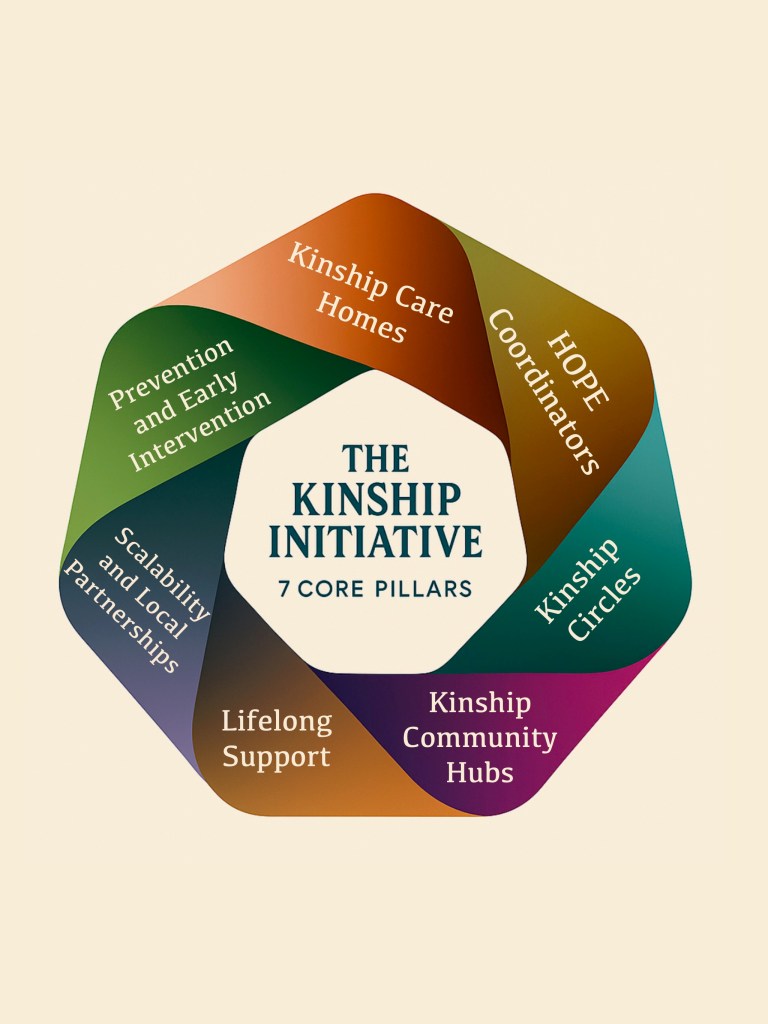
Prevention and Early Intervention
Kinship works to support families long before a crisis escalates. Community-based services like mental health counseling, parenting support, food security, and crisis coaching reduce unnecessary removals and strengthen families in place.
Kinship Care Homes
When children must be temporarily removed for safety, they are placed in local, trauma-informed Kinship care homes—not institutions, not strangers’ houses. These families commit to lifelong connection, keeping children close to their schools, neighborhoods, friends, and siblings whenever possible. The moment a child enters a Kinship care home, they are met with safety, stability, and unconditional welcome.
HOPE Coordinators
Traditional caseworkers are replaced by HOPE Coordinators—trauma-informed, trained advocates who walk alongside the child and their family with healing, stability, and consistent follow-through as their mission. They are the anchor throughout the journey, ensuring the child and family are never alone, never shuffled, and never forgotten. When families feel lost, HOPE Coordinators carry the hope for them—until they’re strong enough to carry it on their own.
Kinship Circles
The Kinship Circle is the full wraparound of trauma-informed care that surrounds every child and family in the Kinship framework. It includes therapy, education support, mentoring, parenting services, peer guidance, and emotional care—for both the child and their family. This is not temporary aid—it is a lifelong circle of care designed to hold, support, and restore.
Kinship Community Hubs
These are the heart of the Kinship Initiative—local centers where anyone in the community can access support, guidance, and trauma-informed services. More than a service provider, each Hub becomes a permanent source of connection.
Think of it like going to your grandparents’ house—they offer wisdom, resources, and love. They see you, know you, and still love you.
Lifelong Support
Kinship doesn’t age kids out. It walks with them into adulthood—for life. Whether someone enters care at five or fifteen, they remain part of the Kinship Circle and Community Hub forever. That’s what healing looks like.
Scalability and Local Partnerships
Kinship is designed to be community-specific and scalable. Rural towns, urban cities, and partnering districts can all implement the Kinship framework based on their unique needs. It is built to grow, adapt for continuous improvement, and be shared nationwide.
If This Were a Wildfire…

When California wildfires strike, we don’t send clipboards and delays. We send everything we’ve got.
The foster care crisis is no different—it’s a decades-long fire we’ve allowed to burn through children, families, and communities.
Kinship is the coordinated, full-force response this disaster demands. Not just to stop the blaze—but to prevent it from returning.
Kinship is fire prevention.
This Isn’t a Crisis Waiting to Happen This Is a Disaster
We keep waiting for a breaking point. But for too many, it’s already come and gone. We’ve seen children carry trauma into adulthood undiagnosed, untreated, unspoken. We’ve watched mothers and fathers fall apart because no one stepped in soon enough. We’ve buried people who should still be here. These aren’t isolated stories. They’re a national pattern. The disaster happened quietly—inside living rooms, courtrooms, and overworked offices. It happened in plain sight, and it’s still happening. Kinship is how we stop normalizing the damage. It’s how we start healing the whole.
Kinship is our Community’s Immunity
The Instinct to Care
When disaster strikes, people show up. Not because they’re told to—but because they feel it. A shared instinct to help. To act. To care.
You’ve seen it on the news.
Or maybe you’ve lived it yourself.
Wildfires. Hurricanes. Tornadoes. Floods.
When homes are ripped from their foundations or burned to the ground—when families lose everything—we show up for each other in the most human, immediate ways.
We Show Up in Big and Small Ways
We bring diapers and bottled water
We deliver meals
We gather clothing, supplies, tools
We volunteer our time to muck out homes, clean debris, hold hands, and offer comfort
And we do it for weeks—for months—long after the headlines have faded
It’s not glamorous
But it’s powerful
It reminds us that in just a short amount of time, when people are united by a shared belief, extraordinary things can happen
Kinship is that belief in action
But this time, the disaster already happened
And it didn’t just hit one state or region—it hit all of us
A Silent Collapse
It wasn’t a storm
It wasn’t a fire
It was a slow, silent collapse of the systems that were supposed to protect us
And now?
The damage is everywhere
Homelessness Incarceration Addiction
Broken families Lost kids Burned-out systems
These are the remnants of a disaster we’ve learned to ignore
This Is Our Moment
If a tornado ripped through your town,
you wouldn’t sit inside and keep watching TV
You’d get up
You’d get out
You’d help.
Well—the disaster is here
And it’s not someone else’s to clean up It’s ours
Kinship Is the Rescue Effort
It focuses our instinct to care into something lasting
Something life-changing
Not a temporary response—a permanent commitment to healing
The Call to All of Us
This is our Community’s Immunity
And it begins with all of us
What’s Next
Cindi is launching the first Kinship pilot in California. With public support, nonprofit partners, and a dedicated team, Kinship will scale city by
city until it becomes the national standard.
This is the future of child welfare
And it starts now
Subscribe to The Kinship Initiative Newsletter
 The Kinship Initiative